
When sourcing pipe and jack stands for volume procurement, most buyers default to brand names as a shorthand for quality. But brand loyalty can blind purchasing teams to mismatched specifications, inflated costs, and overlooked jobsite requirements. A structured evaluation of product fit — not just logo recognition — is what separates a smart buy from an expensive mistake.
The most important factor in choosing pipe and jack stands is whether the product matches your specific working conditions — not the brand printed on it. The right load capacity, height range, head type, and build quality for your actual application will outperform a famous name that doesn't fit the job. Evaluate specifications against real-world use cases first, then compare suppliers on quality consistency, certification, and total landed cost.
I've spent years working with importers, brand owners, and retailers who purchase pipe and jack stands in container-load volumes. Through hundreds of these transactions, one pattern keeps appearing: the buyers who focus on matching product specs to end-user needs consistently report fewer returns, fewer complaints, and better margins. Below, I'll walk you through every factor that matters beyond the brand label.
Why Do Buyers Over-Rely on Brand Names for Pipe and Jack Stands?
It's a natural instinct. When you're placing a large order for pipe and jack stands, choosing a recognized brand feels like a safety net. If something goes wrong, you can point to the brand's reputation. But this mindset introduces real procurement risk.
Brand recognition provides a sense of security, yet it doesn't guarantee that a specific pipe stand model fits your project's load requirements, height range, or environmental conditions. Over-reliance on brands often means buyers skip detailed specification analysis — and that's where costly mismatches happen.
The Brand Premium Problem
In my experience working with importers across North America, Europe, and Australia, I've seen a consistent markup of 15–35%1 on branded pipe and jack stands compared to equivalent OEM-manufactured products with identical materials, tolerances, and load ratings. That premium buys you a logo and, sometimes, a warranty infrastructure — but it doesn't buy you a better-fitting product.
Here's what typically happens:
- A purchasing manager selects a well-known brand because it was used on a previous project.
- The specification review gets abbreviated — "it's a trusted brand, so it'll be fine."
- On the jobsite, the pipe stand's height range is 2 inches too short, or the V-head doesn't accommodate the pipe diameter properly.
- Returns or workarounds eat into the margin that the buyer thought they were protecting.
What Brand Names Actually Signal
To be fair, brands do communicate certain things:
| What Brands Signal | What Brands Don't Guarantee |
|---|---|
| General quality reputation | Fit for your specific application |
| Established distribution | Best price-to-performance ratio |
| Warranty and support channels | Superior raw materials vs. OEM alternatives |
| Market familiarity for resale | Consistent quality across all SKUs |
The key takeaway is that brand is one input into a purchasing decision — not the decision itself. For volume buyers, the real competitive advantage comes from specifying precisely what you need and then finding a supplier who delivers that specification consistently.
The OEM / ODM Alternative
Many of the world's most recognized pipe and jack stand brands source their products from the same manufacturing regions — and often from the same factories — as OEM suppliers. At JSOrient, we've manufactured pipe stands and jack stands since 2016, building on industry experience that goes back to 1998. We've seen firsthand how a private-label product built to the right specification outperforms a branded product that doesn't quite match the application.
What Load Capacity Do Your Pipe and Jack Stands Actually Need?
Load capacity is the single most critical specification for pipe and jack stands, yet it's frequently over-specified or under-specified. Both mistakes cost money. Over-specifying means paying for heavier steel and higher unit costs you don't need. Under-specifying creates safety hazards and liability exposure.
The correct approach is to calculate the maximum weight your pipe stands will support in real working conditions — including the weight of the pipe, any fittings, and dynamic loads from cutting or welding — and then select a stand rated at least 25% above that figure as a safety margin.
Understanding Load Ratings
Pipe and jack stands are typically rated in pounds or kilograms of maximum load capacity. Common ratings in the market include:
| Stand Type | Typical Load Range | Common Applications |
|---|---|---|
| Lightweight pipe stands | 1,000 – 1,500 lbs | Residential plumbing, small-diameter pipe |
| Medium-duty pipe stands | 2,000 – 2,500 lbs | Commercial HVAC, mid-range pipe work |
| Heavy-duty jack stands | 3,000 – 5,000 lbs | Industrial pipelines, large-diameter steel pipe |
| Extra-heavy pipe rollers | 5,000 – 10,000+ lbs | Oil & gas, structural steel fabrication |
How to Calculate Your Real-World Load
Don't rely on the nominal pipe weight alone. Consider these factors:
- Pipe material and wall thickness: Schedule 40 carbon steel pipe weighs significantly more2 per linear foot than Schedule 10 stainless.
- Span between supports: Longer spans increase the load on each individual stand.
- Dynamic forces: Cutting, grinding, and welding introduce vibration and momentary load spikes.
- Accumulated loads: If fittings, valves, or flanges are pre-attached to the pipe section, the total supported weight increases.
I always recommend that buyers create a simple load calculation sheet for their most common pipe configurations. Share it with your supplier. A capable manufacturer can then recommend the exact model and capacity tier that fits your workload — no over-engineering, no under-engineering.
The Cost of Getting Capacity Wrong
Under-specifying load capacity isn't just a performance issue — it's a safety and liability issue. In regulated industries, using a pipe stand below its rated capacity for the actual load can void insurance coverage and violate workplace safety standards3. Over-specifying by one or two capacity tiers might only add $5–$15 per unit, but it wastes money across a 500- or 1,000-unit order.
How Do Height Range and Adjustability Affect Pipe Stand Performance?
A pipe stand with the wrong height range forces workers into awkward postures, slows production, and increases the risk of injury4. Yet height range is one of the most overlooked specifications in bulk procurement because buyers assume "adjustable" means "fits everything."
Pipe and jack stands with the correct height range eliminate improvised shims, reduce setup time, and improve weld quality by keeping the pipe at the optimal working height. The best approach is to survey the actual working heights across your most common jobsite scenarios and select stands whose adjustable range covers at least 90% of those conditions.
Standard Height Ranges
Most pipe stands on the market fall into a few standard height ranges:
| Category | Low Position | High Position | Best For |
|---|---|---|---|
| Low-profile | 20" | 30" | Trench-level work, confined spaces |
| Standard | 28" | 44" | General shop and field use |
| Tall / Hi-boy | 36" | 60" | Elevated pipe runs, standing-height welding |
| Extra-tall | 48" | 72"+ | Overhead pipe installations |
Adjustment Mechanisms Matter
Not all adjustment systems are equal. The three most common mechanisms are:
- Pin-and-hole leg adjustment: Simple, robust, and fast. The legs lock at preset height intervals. Limitation: you can only adjust in fixed increments (typically 1–2 inches).
- Screw-type fine adjustment: Allows precise height tuning within a range. Slower to set, but ideal for alignment-critical work.
- Combination (pin + screw): Coarse adjustment with pins, fine-tuning with a screw. This is the most versatile design and the one I recommend most often for professional-grade applications.
Why This Matters for Bulk Buyers
If you're an importer supplying pipe stands to plumbing contractors or industrial distributors, your end users will judge the product on how quickly and reliably they can set it to the right height. A stand that requires two people and a rubber mallet to adjust will generate returns. A stand with a smooth, one-person adjustment mechanism builds brand loyalty — whether or not it carries a famous name.
Which Head Type Is Right for Your Pipe and Jack Stands?
The head — the top component that actually contacts the pipe — determines how securely and flexibly a pipe stand supports different pipe diameters. Choosing the wrong head type is one of the most common specification errors I see in procurement orders.
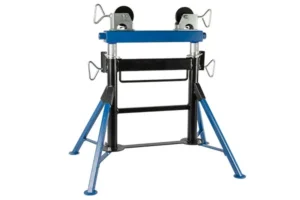
The three primary head types for pipe and jack stands are V-heads, roller heads, and pipe jaws (clamp-style). V-heads are the most versatile for general use, roller heads are essential when pipe needs to move or rotate5, and pipe jaws provide the most secure grip for cutting and threading. Your choice should match the primary task your end users perform.
Head Type Comparison
| Head Type | Best For | Pipe Diameter Range | Allows Pipe Rotation? | Relative Cost |
|---|---|---|---|---|
| V-head | General support, welding, alignment | 1/8" – 36" (varies) | No (static hold) | Low |
| Roller head (single roller) | Feeding pipe through threading machines | 1/2" – 6" | Yes | Medium |
| Roller head (ball transfer) | Multi-directional movement | 1" – 36" | Yes (any direction) | High |
| Pipe jaw / clamp | Cutting, threading, secure hold | 1/8" – 6" | No | Medium |
| Flat head / platform | Irregular shapes, bundles | N/A | No | Low |
Matching Head Type to End-User Application
This is where I've seen the most expensive mistakes. A buyer orders 1,000 V-head pipe stands for a customer whose primary use case is pipe threading. The threader operator needs the pipe to rotate freely — and a V-head creates friction that either damages the pipe coating or stalls the threader. The correct head for that application is a roller stand.
Conversely, a roller head is wrong for welding. The pipe rolls during tack welding, causing misalignment. The welder has to hold the pipe in place manually, which is slow, unsafe, and produces poor-quality welds.
Interchangeable Head Systems
Some pipe and jack stand designs feature interchangeable heads on a common base. This is an excellent option for distributors and retailers serving diverse end-user markets. A single base SKU with three or four head options reduces inventory complexity while giving the end user flexibility. At JSOrient, we offer OEM configurations with interchangeable head systems specifically for this reason — it simplifies logistics for volume buyers.
What Material and Finish Quality Should You Demand?
The steel grade, weld quality, and surface finish of pipe and jack stands directly affect durability, safety, and customer satisfaction. These factors are invisible on a product photo but become obvious within weeks of jobsite use.
For professional-grade pipe and jack stands, demand medium-carbon steel (or equivalent) for structural components, consistent weld penetration with no porosity or cold joints, and a powder-coated or hot-dip galvanized finish6 for corrosion resistance. Request material certificates and sample inspection before committing to volume orders.
Steel Grade and Wall Thickness
The legs and base of a pipe stand take the most stress. Key things to verify:
- Tube wall thickness: Thinner walls reduce weight and cost but also reduce load capacity and dent resistance. For professional-grade stands rated above 2,000 lbs, look for leg tubes with a minimum wall thickness of 2.0 mm (approximately 14 gauge).
- Steel composition: Request mill certificates (MTCs) that confirm the steel grade. This is standard practice for any reputable manufacturer.
- Weld quality: Inspect sample units for full weld penetration, consistent bead profiles, and the absence of porosity, undercut, or spatter.
Surface Finish Options
| Finish Type | Corrosion Resistance | Appearance | Cost | Best For |
|---|---|---|---|---|
| Powder coat | Good | Smooth, uniform color | Medium | General professional use |
| Hot-dip galvanized | Excellent | Gray, textured | Higher | Outdoor, marine, wet environments |
| E-coat (electrocoat) | Good | Smooth, thin film | Medium | Automotive-adjacent applications |
| Paint only | Fair | Smooth | Low | Indoor shop use, budget lines |
Why Sample Inspection Is Non-Negotiable
I cannot stress this enough: never commit to a large order of pipe and jack stands without inspecting production samples. Photos and specification sheets don't reveal weld quality, adjustment smoothness, or finish durability. At JSOrient, we encourage every new customer to request pre-production samples and, when possible, arrange third-party inspection during production. This isn't about distrust — it's about building confidence in the partnership.
How Do Certifications and Compliance Affect Your Purchasing Decision?
Certifications matter, but they're not all equal. Some buyers treat a CE or ISO mark as a blanket guarantee of quality. In reality, certifications confirm that a product or process meets a specific standard at a specific point in time. They must be verified, not assumed.
For pipe and jack stands entering regulated markets, buyers should verify that the product meets relevant safety standards (such as ASME, CE, or AS/NZS), that the manufacturer's quality management system is certified (typically ISO 90017), and that certificates are current and auditable. Treat certifications as documentation to verify — not as a substitute for your own quality evaluation.
Common Certifications and What They Mean
| Certification | What It Covers | Region | Buyer Action |
|---|---|---|---|
| ISO 9001 | Quality management system | Global | Request certificate, verify with issuing body |
| CE Marking8 | Product safety (self-declared or third-party) | EU/EEA | Confirm Declaration of Conformity exists |
| ASME B30.9 / related9 | Rigging and lifting equipment standards | USA | Verify compliance if stands are used in regulated lifting scenarios |
| AS/NZS standards10 | Australian/NZ product safety | Australia, NZ | Confirm compliance for import |
Certifications Are a Starting Point
A certificate hanging on a factory wall tells you that, at some point, an auditor found the system or product compliant. It doesn't tell you what happened on the production line last Tuesday. This is why ongoing quality control — incoming material inspection, in-process checks, and pre-shipment inspection — matters more for volume procurement than any single certificate.
At JSOrient, our quality management processes have been in place since our founding, and we welcome customer audits and third-party inspections. We believe that transparency builds the long-term partnerships our business depends on. That said, I always recommend that buyers independently verify any certification claims from any supplier — including ours.
Frequently Asked Questions
Are OEM pipe and jack stands as reliable as branded ones?
Yes, when sourced from a qualified manufacturer with proper quality controls. Many branded pipe stands are manufactured by the same OEM factories that supply private-label products. The key is verifying material specifications, weld quality, and load testing — not the brand label.
What is the standard load capacity for a pipe jack stand?
Most professional-grade pipe jack stands are rated between 2,000 and 2,500 lbs for general commercial and industrial use. Heavy-duty models can support 5,000 lbs or more. Always choose a capacity rated at least 25% above your maximum expected working load.
How do I choose between a V-head and roller head pipe stand?
Choose a V-head when the pipe needs to remain stationary — for welding, alignment, or general support. Choose a roller head when the pipe needs to rotate or slide — for threading, cutting, or feeding through machinery. Matching the head type to the task prevents jobsite problems.
Can I customize pipe and jack stands with my own branding?
Absolutely. OEM and private-label manufacturing allows you to specify materials, dimensions, finishes, and packaging with your brand identity. This is standard practice for importers and brand
"What is a fair markup for sourcing and delivering materials?", https://www.facebook.com/groups/506828769926755/posts/995733444369616/. Studies on B2B brand equity indicate that recognized brands in industrial markets command a significant price premium, often ranging from 15% to over 30% depending on the product category. Evidence role: statistic; source type: research. Supports: the typical price premium or markup associated with branded industrial equipment compared to OEM alternatives. Scope note: The exact markup percentage varies widely by geographic region and specific product complexity. ↩
"Steel Pipe Weight Chart (Schedule 40 and 80 dimensions ...", https://www.octalsteel.com/pdf/steel-pipe-weight-chart.pdf. Standard pipe dimension tables (such as ASME B36.10M and B36.19M) show that Schedule 40 carbon steel has a substantially thicker wall and higher weight per unit length than Schedule 10 stainless steel of the same nominal size. Evidence role: statistic; source type: encyclopedia. Supports: the weight difference between Schedule 40 carbon steel and Schedule 10 stainless steel pipes. Scope note: This comparison assumes identical nominal pipe diameters. ↩
"1915.83 - Utilities. | Occupational Safety and Health ...", https://www.osha.gov/laws-regs/regulations/standardnumber/1915/1915.83. Under OSHA General Industry and Construction standards (e.g., 29 CFR 1926), employers are required to ensure all material handling and support equipment is rated for the loads they carry to prevent structural collapse. Evidence role: expert_consensus; source type: government. Supports: workplace safety regulations requiring equipment to be used within rated load capacities. Scope note: Specific enforcement may depend on local jurisdiction and the exact nature of the construction or fabrication site. ↩
"The relation of musculoskeletal disorders to ergonomic work ...", https://pmc.ncbi.nlm.nih.gov/articles/PMC12262049/. Ergonomic evaluations of welding and fabrication tasks consistently show that working at non-optimal heights increases the risk of neck, shoulder, and lower back musculoskeletal disorders. Evidence role: mechanism; source type: paper. Supports: the link between non-adjustable or poorly adjusted work heights and musculoskeletal strain in welding and pipefitting. Scope note: The study focuses on general manual welding tasks rather than pipe stands specifically. ↩
"Pipe Threading Machine Policy & Procedure", https://ajtraining.edu/ULWSiteResources/ajtraining/Resources/documents/safety%20policies/pipe-threading-machine.pdf. Technical guides for pipe welding and threading emphasize the use of ball-transfer or roller-head stands to minimize friction and allow smooth rotation during continuous welding or feeding. Evidence role: mechanism; source type: other. Supports: the mechanical function of roller heads in facilitating pipe rotation and longitudinal movement. Scope note: Roller heads must be properly aligned to prevent axial drift during rotation. ↩
"Powder Coating vs. Galvanizing", https://www.keystonekoating.com/blog/powder-coating-vs-galvanizing/. Corrosion studies show that while powder coating provides an excellent aesthetic barrier, hot-dip galvanizing offers superior sacrificial protection and durability in harsh outdoor or marine environments. Evidence role: mechanism; source type: research. Supports: the comparative corrosion resistance of powder coating and hot-dip galvanizing on structural steel. Scope note: The performance of both finishes depends heavily on surface preparation and application quality. ↩
"4.3 Determining the Scope of the Quality Management ...", https://www.iso-9001-checklist.co.uk/4.3-how-to-write-your-scope-for-iso-9001-with-7-examples.htm. According to the International Organization for Standardization, ISO 9001 specifies requirements for a quality management system where an organization needs to demonstrate its ability to consistently provide products that meet customer and regulatory requirements. Evidence role: definition; source type: institution. Supports: the definition and scope of the ISO 9001 quality management standard. Scope note: ISO 9001 certifies the management process rather than guaranteeing the physical quality of individual product units. ↩
"CE marking", https://en.wikipedia.org/wiki/CE_marking. The European Commission states that CE marking indicates a product has been evaluated by the manufacturer and deemed to meet EU safety, health, and environmental protection requirements. Evidence role: definition; source type: government. Supports: the legal definition and compliance requirements of the CE marking in the European Economic Area. Scope note: For many product categories, CE marking is a self-declaration by the manufacturer rather than a third-party certification. ↩
"Jack Stand Testing | ESCO", https://esco.net/tag/jack-stand-testing/. While ASME B30.1 covers jacks, portable support stands are more directly governed by the ASME PASE (Portable Automotive Service Equipment) standard, which defines safety and testing requirements for jack stands. Evidence role: definition; source type: institution. Supports: the relevant ASME standards governing portable jacks and support stands. Scope note: ASME PASE is primarily designed for automotive service, though its safety principles are widely referenced for industrial stands. ↩
"Vehicle support stands mandatory standard", https://www.productsafety.gov.au/business/search-mandatory-standards/vehicle-support-stands-mandatory-standard. Standards Australia defines specific safety requirements for support stands under standards such as AS 2538, which outline nominal load capacities, stability tests, and structural integrity requirements. Evidence role: definition; source type: government. Supports: the Australian and New Zealand standards governing support stands and load-bearing equipment. Scope note: AS 2538 specifically targets vehicle support stands, though its testing methodologies are often adapted for industrial pipe stands. ↩
发表回复